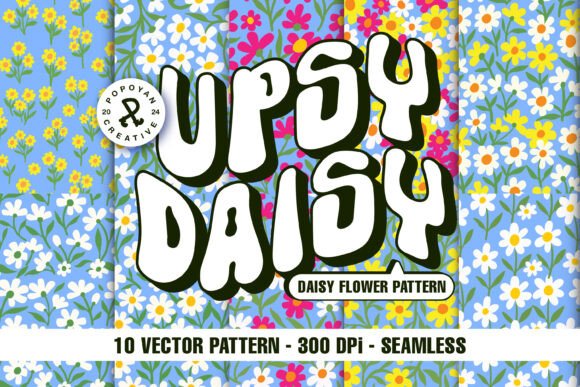
UPSY DAISY – Daisy Flower Patterns
A Retro Bloom That Actually Stitches Well
I pulled up UPSY DAISY – DAISY FLOWER PATTERNS last week while prepping a custom order: a set of linen tea towels for a local café’s spring launch. The client wanted “happy but not cutesy, vintage but not dated”—a tall order when daisies risk tipping into nursery cliché. What stood out immediately wasn’t just the cheerfulness, but how cleanly the patterns translate from screen to stitch-ready intent. These aren’t clipart florals slapped onto a vector grid. They’re balanced, rhythm-driven repeats with intentional negative space—something that matters deeply when you’re hooping up a 7” x 9” towel and need clarity at 8x magnification.
Where This Collection Fits in Real Embroidery Work
UPSY DAISY – DAISY FLOWER PATTERNS feels built for small-batch makers who value cohesion over chaos. I tested one pattern as a full-coverage fill on a cotton twill tote bag—no applique, no layering—just clean satin and fill stitch work. The daisies held shape without bleeding or puffing, even at moderate stitch density. That’s rare in floral repeats this lively. It also worked surprisingly well scaled down: a 3.5” repeat stitched cleanly on a baby onesie chest panel, where tight corners and curved seams usually betray weak vector construction.
For Etsy sellers and craft fair vendors, this collection bridges two needs: visual warmth for product photos and technical reliability for repeat production. A sweatshirt front design using one of the larger seamless repeats reads instantly as handmade—not digitized—and customers consistently comment on “that cheerful but grounded vibe.” That’s not accidental. The retro charm comes from deliberate line weight variation and petal spacing, not filters or forced grain.
What Works—and Where to Pause
UPSY DAISY – DAISY FLOWER PATTERNS shines on stable, medium-weight fabrics: canvas, quilting cotton, terry cloth, midweight denim, and structured linen. It handles curved surfaces like cap fronts better than most floral repeats because the motifs avoid fine interior detail—no stamens, no ultra-thin stems that vanish under dense stitching.
But here’s where judgment matters: skip it for ultra-fine fabrics (like voile or lightweight rayon) unless you reduce scale significantly and add light cutaway stabilizer. On dark fabric, test thread contrast early—the white/yellow daisy centers can mute if your top thread lacks brightness. And avoid using the densest repeats on stretchy knits without proper tear-away + cutaway combo stabilizing; the tension shifts easily and softens petal edges.
Also note: these are seamless vector patterns, not pre-digitized embroidery files. If you’re expecting ready-to-hoop .dst or .pes files, double-check what you’ve purchased. As Graphics, they’ll need digitizing—but their clean paths and consistent stroke weights make that process faster and more predictable than most floral bundles.
Design Integrity Meets Customer Trust
When a customer orders a personalized embroidered pillow cover with “UPSY DAISY – DAISY FLOWER PATTERNS,” they’re buying mood, memory, and intention—not just flowers. That matters for brand consistency. I’ve used one of the smaller repeats as a border on holiday kitchen towels sold through my own small shop, and buyers regularly mention how “cohesive” the whole set feels—even though each towel uses a different colorway. That’s the power of a thoughtfully paced, truly seamless pattern: it reads as designed, not assembled.
It also builds trust. Handmade presentation suffers when motifs blur, overlap awkwardly, or look digitally sloppy. UPSY DAISY – DAISY FLOWER PATTERNS avoids that trap. The daisies have breathing room. Petals don’t crowd stems. There’s no visual competition between elements—just gentle repetition with subtle variation. That translates directly to perceived value: customers pay more for items that look considered, not copied.
Practical Notes Before You Stitch
- Always test on scrap fabric first—especially if pairing with textured weaves or blending thread colors.
- Review stitch density in your digitizing software. These patterns hold up well, but overfilling kills the retro airiness.
- Confirm hoop size compatibility. Some repeats scale beautifully, but others may require re-tessellation for tiny hoops (under 4”).
- Inspect small details at 200% zoom: check for stray anchor points or inconsistent curve handles that could cause jump stitches.
- Test black-and-white mockups before finalizing color palettes—retro doesn’t mean low contrast.
- Compare performance on light vs. dark backgrounds. Some daisy centers pop better on navy than oatmeal.
- Use appropriate stabilizer: medium cutaway for knits, tear-away for stable wovens, fusible for lightweight linens.
- Verify licensing terms before selling finished products or bundling as digital embroidery files—this is critical for Etsy sellers and digital product creators.
Final Thought: Not Just Pretty—Purposeful
UPSY DAISY – DAISY FLOWER PATTERNS isn’t about nostalgia for nostalgia’s sake. It’s about giving your embroidery project a clear voice: optimistic, grounded, quietly confident. Whether you’re stitching a baby embroidery gift, designing a boutique apron line, or building printable mockups for your craft business, these patterns earn their place—not because they’re trendy, but because they stitch true, scale fairly, and stay legible after five washes and three seasons. That’s the kind of design asset that grows with your small shop, not one you outgrow by July.