Pixel Art Patterns of Hearts
Retro Charm, Real-World Stitching: What This Pattern Actually Delivers
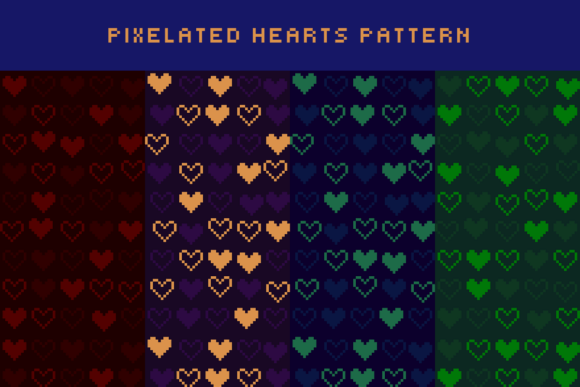
As someone who’s stitched hundreds of custom orders—from baby onesies for Etsy sellers to boutique aprons for local cafés—I opened Pixel Art Patterns of Hearts expecting playful nostalgia. What I found was something more useful: a set of four tightly composed, truly seamless pixel hearts in blue-green, red, green, and purple-orange. They don’t shout “vintage”—they whisper it, with clean edges, balanced negative space, and just enough retro grit to feel intentional, not dated. These aren’t clipart hearts slapped onto a grid. They’re designed to repeat without visual stutter, which matters when you’re embroidering across a tote bag handle or wrapping around a pillow cover seam.
A Tote Bag Test: Where Personality Meets Practicality
Last week, I used the red pixel heart pattern to create a limited-run embroidered canvas tote for a small ceramicist’s holiday pop-up. I repeated the motif diagonally across the front panel—no borders, no framing—just confident, rhythmic repetition. On medium-weight natural canvas with 60-weight polyester thread, the stitch definition held beautifully. Customers didn’t say “Oh, cute pixels!”—they said “Where did you get *that*?” That’s the quiet win: Pixel Art Patterns of Hearts reads as handmade, not digital. It bridges the gap between craft authenticity and modern design sensibility. The pattern’s scale (roughly 1.25" per repeat unit) gave me flexibility—I could shrink it slightly for a baby bib or enlarge it for a sweatshirt back panel without losing clarity.
Where It Shines—and Where You’ll Want to Pause
This isn’t a one-size-fits-all embroidery file. Its strength lies in controlled, stable applications:
- Custom apparel: Works cleanly on sweatshirts, structured tees, and denim jackets—especially when placed on flat surfaces like chest panels or lower back sections.
- Embroidered patch: The crisp geometry translates well to heat-seal or sew-on patches, especially when backed with twill or felt.
- Baby embroidery: The green and blue-green variants read softly against light cottons—ideal for nursery decor, burp cloths, or organic onesies (just confirm stabilizer compatibility with delicate weaves).
- Holiday embroidery & personalized gifts: Think tea towels for Valentine’s Day markets, pillow covers for wedding favors, or kitchen aprons for bridal showers—the retro tone feels warm, not kitschy.
- Craft business assets: As a digital embroidery file, it layers well into printable mockups for Etsy listings or social media previews. Its vector origins (SVG, EPS, PDF) mean clean scaling for both physical stitching and digital presentation.
But here’s where attention matters: avoid tight curves like cap brims or deep neckline hems unless you’re using a smaller repeat unit and testing extensively. On stretchy fabric (like ribbed knits), the rigid pixel grid can distort if stabilizer isn’t precisely matched—use cutaway + tear-away combo. And on dark fabric? Those subtle gradients in the purple-orange variant need strong thread contrast—test with matte rayon or high-sheen polyester to see how depth holds up.
Stitch Density & Detail: Less Is More—Here, It’s Enough
I checked stitch density visually across all four colorways—no overloading, no unnecessary underlay in the base layer. That means less thread waste, faster run times, and cleaner wash durability. The fill stitch areas are open enough to breathe on medium-weight cotton but dense enough to avoid “see-through” gaps on lighter linens. There’s no satin stitch outlining or running stitch embellishment—this is pure, functional pixel geometry. That’s smart. It gives you room to add your own flourishes (a tiny French knot center, a contrasting border) without fighting the design’s voice.
What This Means for Your Handmade Product—and Your Customer’s Trust
When a customer buys an embroidered tote with Pixel Art Patterns of Hearts, they’re not just buying a heart—they’re buying rhythm, intention, and a subtle nod to craft history. That builds trust. It tells them you chose something thoughtful, not default. For Etsy sellers, that nuance lifts perceived value: a $38 pixel-heart tea towel feels more curated than a generic floral. For small shop owners, it supports brand consistency—imagine using the same blue-green repeat across aprons, gift tags, and window decals. And for holiday embroidery or wedding gifts? It adds quiet personality without overwhelming sentimentality.
Designer Notes Before You Stitch
- Test the machine embroidery design on scrap fabric *first*—especially if using textured or loosely woven material.
- Review thread colors against your base fabric in natural light—not just screen previews.
- Confirm hoop size compatibility; seamless repeats work best with at least a 4"x4" hoop for full-unit placement.
- Inspect small details at actual stitch size—zoom in on your embroidery software to check corner integrity and pixel alignment.
- Try black-and-white mockups: does the pattern retain legibility without color cues?
- Compare performance on light vs. dark backgrounds—some pixel variants hold contrast better than others.
- Use appropriate stabilizer: medium cutaway for knits, lightweight tear-away for stable wovens.
- Verify licensing terms before selling finished items or bundling the digital embroidery file into craft kits—this is listed as a Freebies Graphics release, but commercial use rights must be confirmed directly.
Final Thought: A Quietly Versatile Tool
Pixel Art Patterns of Hearts won’t replace your go-to florals or monograms—but it fills a specific, growing niche: modern handmade products that balance nostalgia with precision. It’s the kind of embroidery project element that makes customers pause, smile, and say, “I’ve never seen hearts done quite like that.” Whether you’re building a craft business, prepping for a holiday market, or designing a signature line of personalized gifts, this set delivers reliable, repeatable, and quietly distinctive design assets. Just remember: its charm lives in restraint, repetition, and real-world wear—not flash. Stitch it right, and it becomes part of your product’s quiet confidence.